1. Project Context & Product Breadth
Bybull operates in a fast-paced market encompassing Trade (spot, perpetual contracts, equities), Predictions (sports and event markets), native Wallet services, and multi-country fiat On-ramps.
As consumer adoption scaled, product teams wanted to ship experimental features rapidly—including conversational AI market analytics and personalized price alert engines. The platform needed engineering foundations capable of supporting concurrent feature experiments without risking the core reliability of financial operations.
2. The Engineering Problem
Early product iterations had produced tightly coupled backend models. Changes to the predictions settlement pipeline risked cascading failures in wallet ledger logic, while slow external dependencies could exhaust connection pools needed by the spot trading engine.
The challenge was architectural and organizational: how to decouple core domain logic, establish strict schema contracts, and integrate high-latency LLM inference pipelines without freezing customer feature releases or initiating a risky multi-month rewrite.
3. Role & Responsibilities
I worked across backend systems to establish scalable engineering practices:
- Modularized monolithic services into explicit domain boundaries (Trade, Predictions, Wallet, On-ramp).
- Designed an asynchronous AI inference and notification ingestion pipeline for automated market insights.
- Introduced strict contract validation schemas and transactional message queues between domains.
- Set up standardized delivery pipelines and structured telemetry to observe service behavior in real time.
4. The Three Engineering Foundations
Domain Architecture
Rather than jumping blindly to distributed microservices, we organized the codebase into modular domain boundaries with strict internal APIs. Each domain encapsulates its state models and business invariants, preventing leaky abstractions while keeping deployment straightforward.
Contracts & Reliability
Implemented strongly-typed data contracts and idempotent consumers for transaction processing. Even during unexpected network blips or external aggregator downtime, financial ledger updates maintain strict consistency guarantees.
Delivery & Observability
Instituted comprehensive telemetry: structured logging, tracing across domain boundaries, and automated canary deployment gates. Performance regressions and error anomalies are detected immediately at deploy time.
5. Implementation Highlight: AI → Alerts Pipeline
To power natural language market summaries and condition-based alerts, we built an asynchronous worker pipeline. When LLM models evaluate market sentiment or detect pattern shifts, outputs are serialized into validated schema payloads and pushed through a distributed queue.
This decoupled architecture shields primary transaction services from LLM latency spikes, ensuring user trading operations remain fast and uninterrupted even during volatile market moments.
6. Conceptual Architecture Study
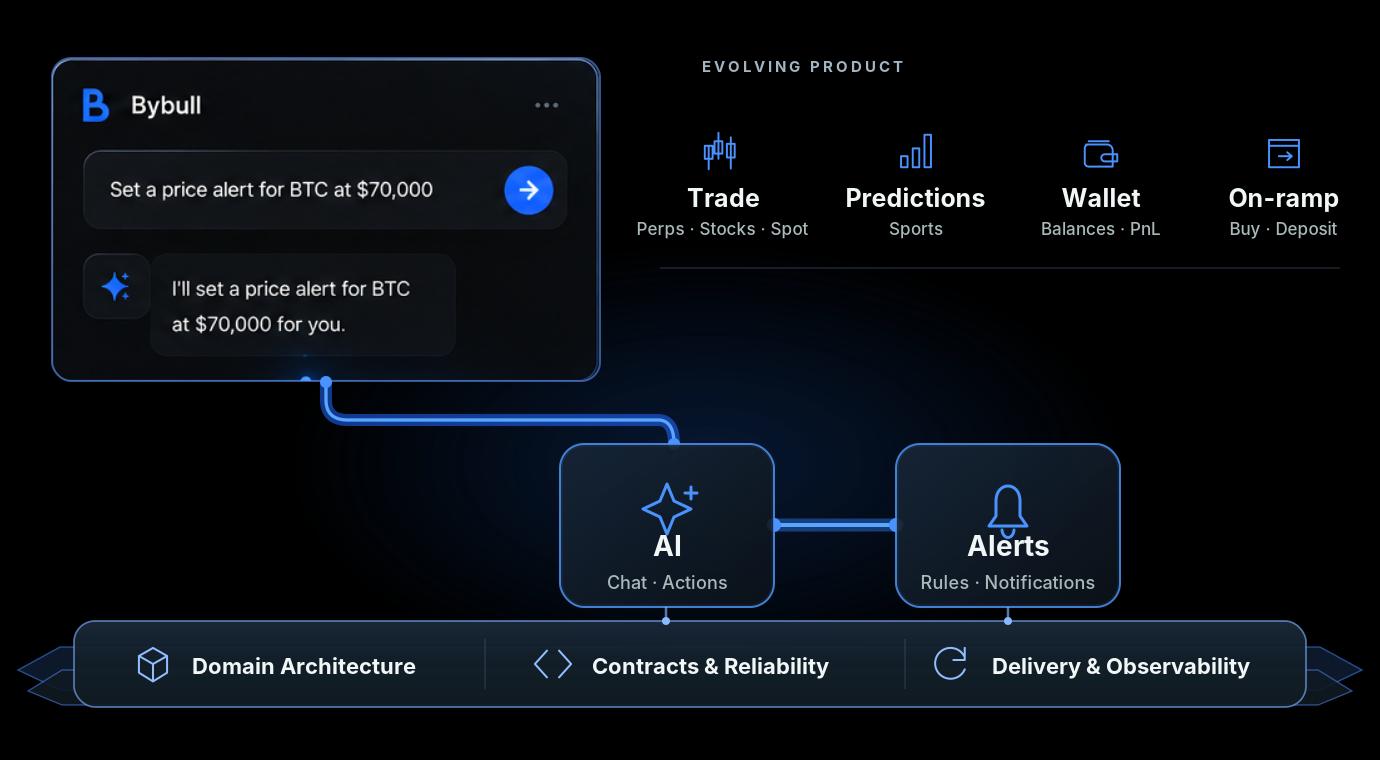
Conceptual system diagram · Illustrating domain boundaries (Trade, Predictions, Wallet, On-ramp), the three foundation pillars, and the AI → Alerts pipeline
7. Measurable Outcomes & Evidence
- Decoupled product development: Teams shipped independent features across Trade and Predictions without coordinating monolithic locksteps.
- Resilient transaction rails: Idempotent consumer design eliminated double-processing edge cases in payment flows.
- Zero-downtime foundation rollout: Successfully refactored domain boundaries and delivery infrastructure while production trading remained live.
- Observability coverage: 100% of domain boundary calls covered by structured tracing and health monitors.